

When most people think about improving their lawn, they jump straight to fertilizer schedules, irrigation systems, or weed control products. But there’s a quieter, more foundational practice that influences turf health more than almost anything else: mowing height.
It’s simple, it’s free, and it has a bigger impact on your lawn’s long-term performance than many homeowners realize. Whether you manage a backyard lawn or acres of turf, understanding mowing height is one of the smartest steps you can take toward healthier, greener grass.
The Science Behind Mowing Height
Grass blades aren’t just something to cut; they act as the plant’s solar panels and food factories. The more leaf surface you leave, the more energy the plant can produce through photosynthesis. That energy fuels everything the turf needs to survive and thrive, including:
- – Carbohydrate storage in the roots and crown
- – New leaf and tiller production, originating from the crown
- – Recovery from heat, drought, and traffic stress
Cutting too low removes excessive amounts of this energy-producing tissue and is perhaps the single most detrimental thing someone can do to their lawn. The plant is forced to burn stored carbohydrates to rebuild leaves instead of strengthening roots or defending against stress. Over time, repeated low mowing weakens the turf, making it more vulnerable to decline.
Deeper Roots, Stronger Lawn
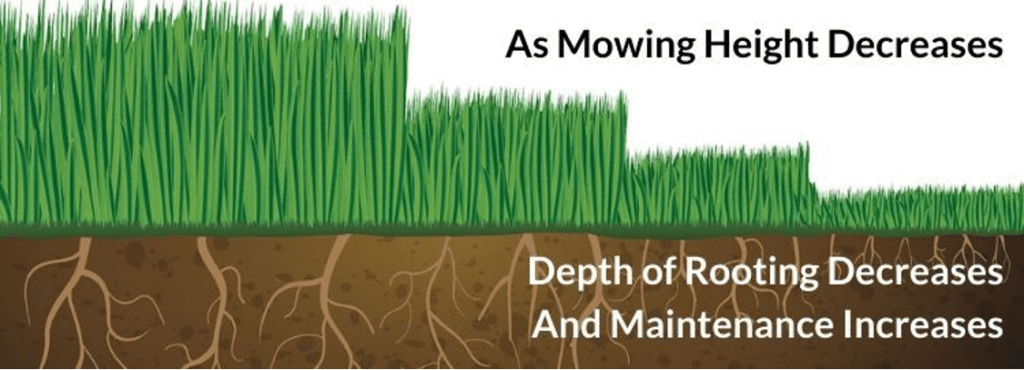
One of the most direct benefits of proper mowing height is improved root depth. Taller grass supports:
- – Longer, denser root systems
- – Better nutrient uptake
- – Greater drought tolerance
- – Stronger anchoring and stability
Short-cut turf often develops shallow roots because the plant is constantly trying to regrow lost leaf tissue. This is why lawns cut too low struggle during summer heat — they simply don’t have the root mass to support themselves.
Better Moisture Retention
Mowing height also shapes the microclimate at the soil surface. Taller turf naturally shades the soil, which:
- – Reduces evaporation
- – Keeps soil temperatures cooler
- – Improves water infiltration
- – Supports beneficial soil microbes
In regions like ours, where summer heat can quickly dry out shallow-rooted turf, raising the mowing height is one of the easiest ways to conserve water and maintain turf quality. Visually, a lawn that is mowed longer will retain its green color far longer than one that is mowed shorter.
Natural Weed Suppression
A healthy, dense lawn is the best weed control strategy available! Proper mowing height helps prevent weeds by:
- – Blocking sunlight from reaching weed seeds
- – Allowing turf to outcompete weeds for water and nutrients
- – Keeping soil temperatures cooler, discouraging warm-season weeds like crabgrass
- – Reducing soil disturbance that brings weed seeds to the surface
Many homeowners rely heavily on herbicides when simply raising the mower deck would dramatically reduce weed pressure. Proper mowing reduces pesticide use!
Improved Pest and Disease Resistance
Stressed turf is an open invitation for pests and disease. Proper mowing height promotes:
- – Thicker turf density
- – Stronger cell walls
- – Better airflow through the canopy
- – Improved stress tolerance
Low mowing height weakens the plant, making it more susceptible to diseases like dollar spot, leaf spot, and brown patch; especially during humid summer weather. This is also a great time to make sure mower blades are sharp. When blades are dull, the grass blade is shredded apart instead of cut cleanly. The wound from a dull blade makes the plant even more prone to disease.
The One-Third Rule for Lawn Mowing
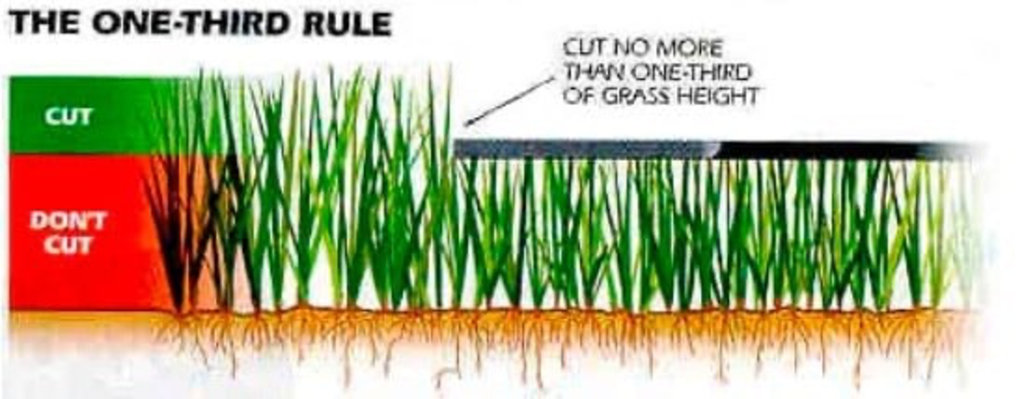
No matter what height you choose, one principle remains constant: Never remove more than one-third of the leaf blade at a time.
Removing too much at once shocks the plant, exposes the crown, and can lead to scalping. This may require more frequent mowings when the grass is growing rapidly, which can be a challenge when trying to balance a busy schedule. If your lawn gets too tall, raise the deck and bring it down gradually over multiple mowings.
Recommended Mowing Heights
Different grass species thrive at different heights. Here’s a practical guide:
Grass
Ideal Height
Notes
Kentucky Blue Grass
2.5 – 3.5″
Prefers higher mowing in summer; lower heights increase stress.
Perennial Grass
2 – 3″
Fine texture; needs consistent moisture; avoid cutting too low.
Tall Fescue
3 – 4″
Deep-rooted; higher mowing maximizes drought tolerance.
Fine Fescue
2.5 – 3.5″
Shade-tolerant;low mowing causes thinning.
Zoysia
1 – 2″
Dense and slow-growing; sharp blades are essential.
A Closer Look at Zoysiagrass
You may have noticed the inclusion of zoysiagrass to the list above! Zoysiagrass is a warm season turf that has good cold tolerance. Because of that, it has found its way into Iowa lawns. It spreads aggressively via horizontal roots and stems, so the amount of area covered by zoysiagrass has methodically increased through the years. If you happen to be reading this AND have an extensive stand of zoysiagrass, you get to live by a different set of rules!
As outlined above, zoysiagrass THRIVES at a mowing height of 1-2”. Since it is a warm-season grass, it does not react the same to heat and humidity as our cool-season grasses. It has its thickest, most dense growth habit at the lower mowing heights. In this case, the lowest height setting on your mower might be the correct one!
The Bottom Line
Mowing height isn’t just a cosmetic choice — it’s a fundamental part of turfgrass health. By keeping your mower deck a little higher, you’re giving your lawn deeper roots, better moisture retention, stronger natural defenses, and a more resilient foundation overall.
It’s one of the simplest, most effective changes you can make, and it pays off every time you step outside and see a lawn that’s greener, thicker, and healthier.


No comment yet, add your voice below!